Welcome to the comprehensive repair protocol for your Whirlpool washing machine. Designed for individuals looking to perform a Moderate difficulty repair, this step-by-step tutorial demystifies the troubleshooting process. Most users complete this repair in 45-90 min. We cover everything from initial safety precautions to the final component reassembly, ensuring a successful outcome.
Difficulty: Moderate • Est. Cost: $0 (reset/load balance) - $20-$105 for belt, splutch, actuator, or lid-lock parts • Time: 45-90 min
Safety Warning: Warning: Live voltage can be extremely dangerous. Disconnect the main power supply to your Whirlpool unit prior to inspecting internal wiring or mechanical parts.
1. Understanding Why This Washer Won't Spin
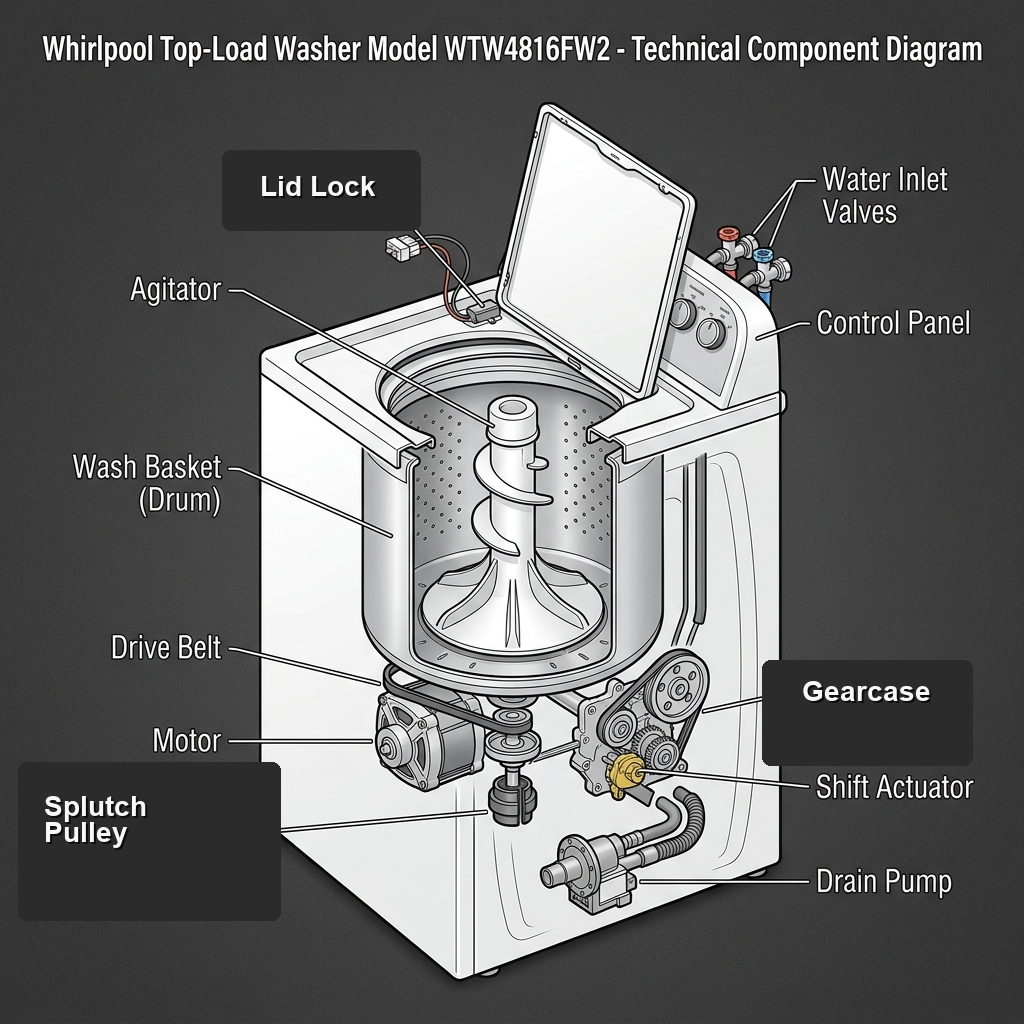
The Whirlpool WTW4816FW2 is a Whirlpool VMW top-load washer that uses a belt, a splutch cam/pulley, and a shift actuator to move between wash and spin. It is not the older direct-drive design with a rubber motor coupling, so the best diagnostic path is different from older Whirlpool top-load guides.
- A true no-spin complaint on this model usually looks like one of three patterns: the washer drains but the basket never ramps up to full speed, the washer makes a clicking or humming sound and stops with wet clothes, or the machine aborts spin because the tub goes badly out of balance.
- Start with a quick empty-basket test. Run Drain and Spin with no laundry inside. If the lid never locks, go straight to Section 2. If the motor runs but the basket barely moves, go to the belt and splutch checks in Section 3. If the basket starts to spin but slams the cabinet or quits, jump to the suspension and basket checks in Section 5.
2. Checking the Lid Lock and Lid Strike First
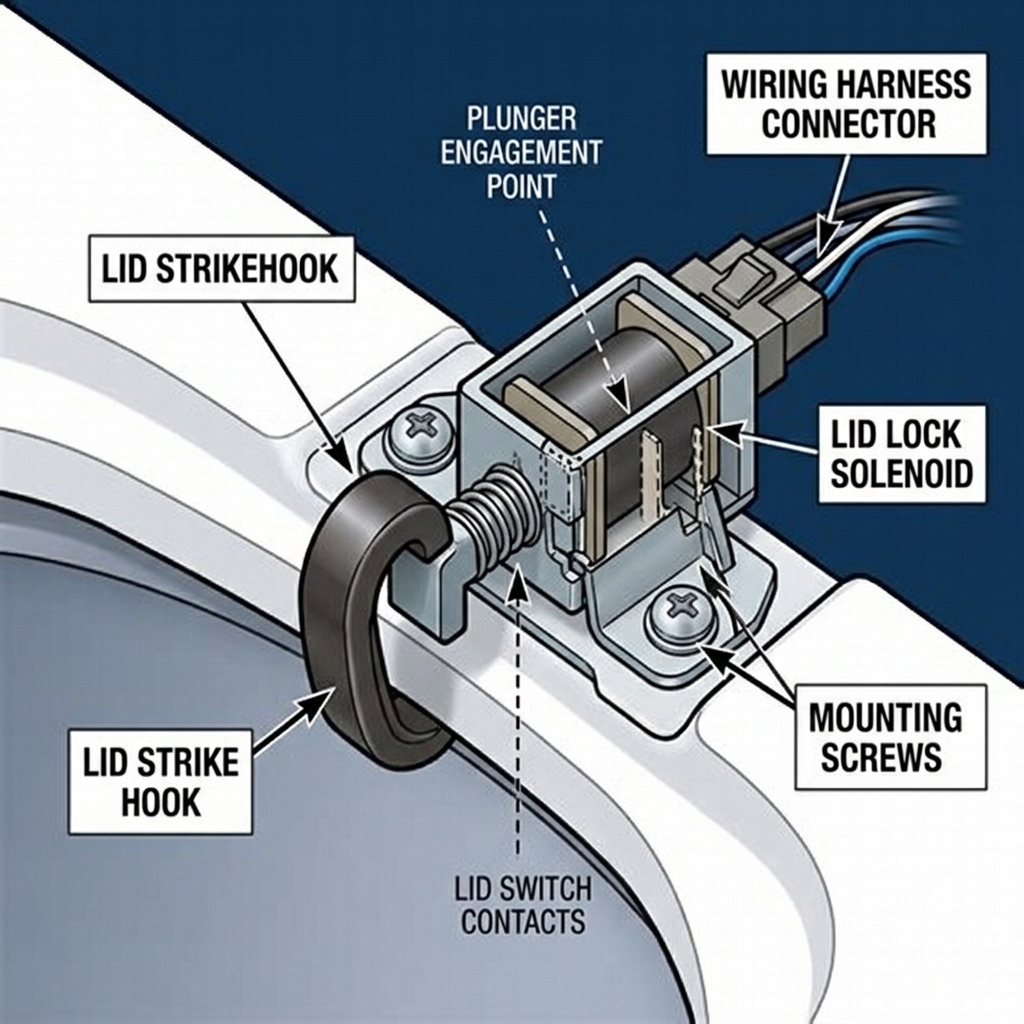
This washer will not enter a real spin cycle until the control sees a successful lid-lock signal. If the lid clicks repeatedly, the lock light never stays on, or the cycle stalls right before spin, fix the lid-lock issue before chasing the driveline.
- Inspect the plastic strike on the lid for cracks, rounding, or bending. On WTW4816FW2, the common parts are the lid lock assembly W11307244 and the matching strike W10837741. A damaged strike can make the lock sound active without ever proving 'locked' to the control.
- Unplug the washer and inspect the lock harness for rubbed insulation, moisture, or a loose connector. If you have a meter, check the lock assembly against the tech sheet for your serial revision. Repeated clicking with no solid lock light is often enough evidence to replace the lock on this platform.
- Do not bypass the lock to keep testing. If the machine cannot confirm the lid is locked, any spin diagnosis downstream becomes unreliable.
3. Inspecting the Drive Belt and Splutch Cam
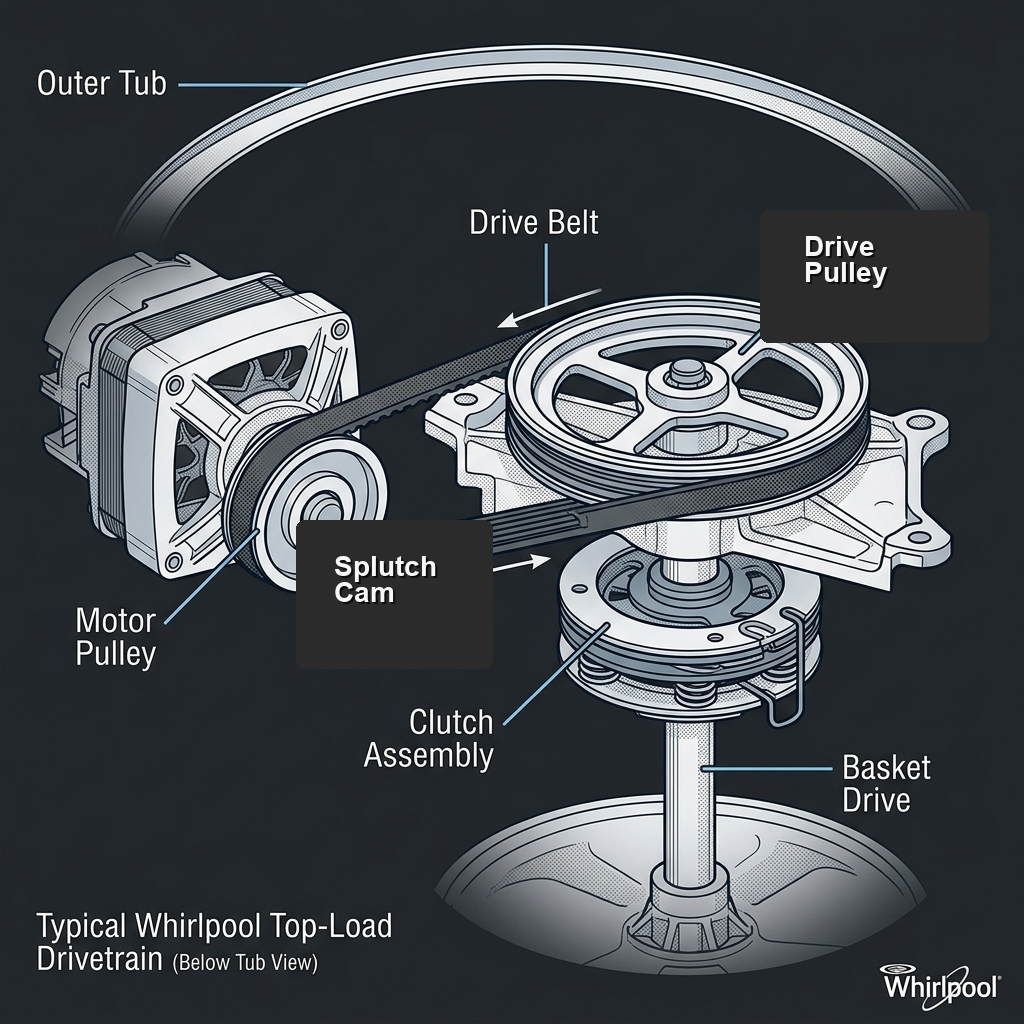
The most useful underbody check on WTW4816FW2 is the belt-and-splutch assembly. Whirlpool lists the main drive belt as WPW10006384 and the splutch kit as W10721967. If either part slips, the motor may run while the basket barely turns or never reaches full spin speed.
- Unplug the washer, shut off the water, and carefully lean the machine back so you can access the underside. Remove the lower shield or belt cover if fitted. Look for belt glazing, slack, black dust, melted plastic, or a pulley that wobbles instead of turning smoothly.
- The splutch is the cam-and-pulley assembly on the bottom of the gearcase. When it wears out, you may hear grinding or chatter during the shift into spin, or the basket may start and stop instead of accelerating cleanly. Replace the complete splutch kit rather than mixing old and new pieces.
- If the belt is intact but the splutch teeth are rounded or the cam feels sloppy, the washer will often fail spin with no dramatic error code. This is one of the most common mechanical causes of wet-clothes complaints on this exact belt-drive platform.
4. Testing the Shift Actuator and Recalibrating
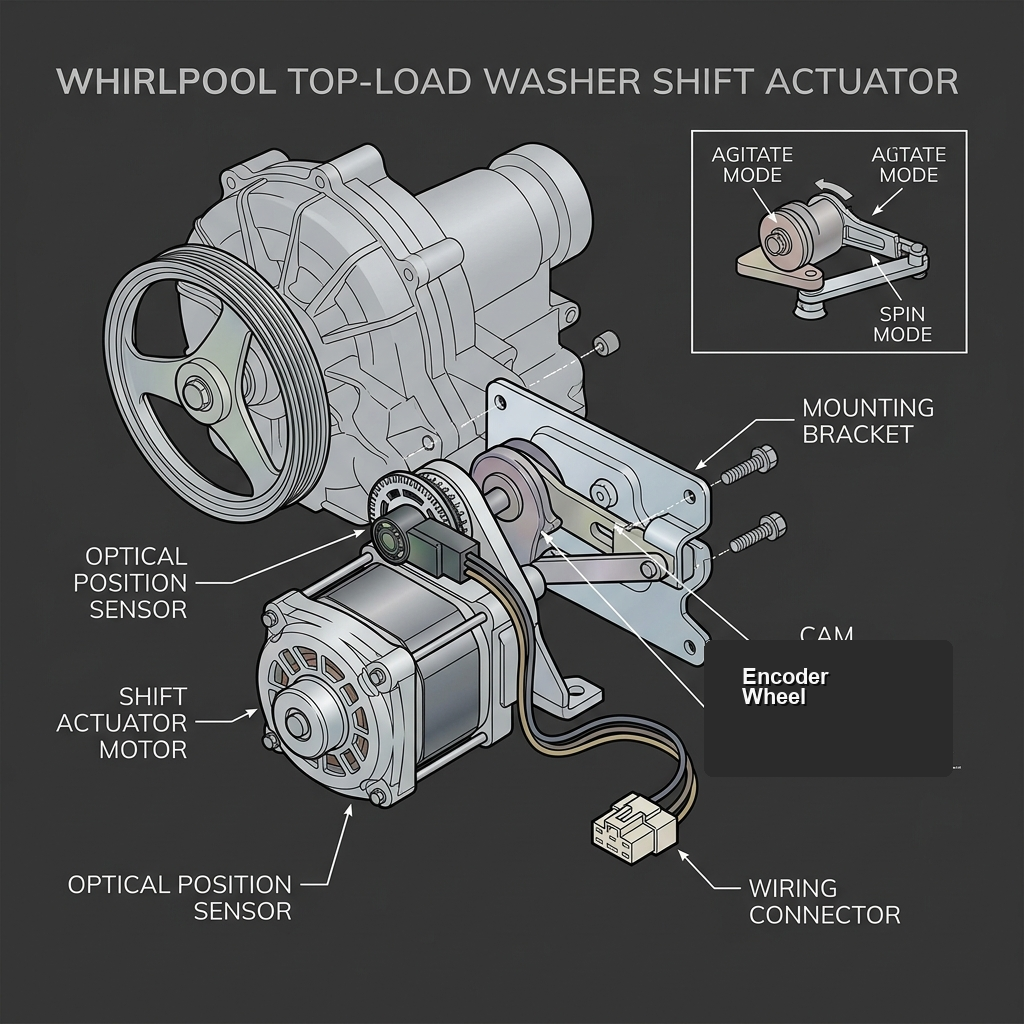
If the washer agitates, drains, and then never properly shifts into spin, the 6-pin shift actuator is a prime suspect. Depending on serial range and supplier substitution, this part is commonly sold as W10913953 or Whirlpool superseding number W11481722.
- The actuator sits beside the splutch underneath the machine. Check for a cracked housing, stripped lever arm, or a loose 6-pin connector. If the actuator cannot report position correctly, the control does not know whether the washer is in agitate mode or spin mode and the cycle may stall or loop.
- Use the tech sheet under the console to run service diagnostics if available. Shifter or basket-speed style faults point back to the actuator, splutch, belt, or gearcase before they point to the main control board. If the actuator motor tests open or the mechanism does not move during diagnostics, replace it.
- After actuator replacement, run the calibration cycle before testing with laundry. Without recalibration, the control may keep behaving like the old actuator is still installed.
5. Checking Load Balance, Suspension, and Basket Drive Wear
Not every spin failure is a dead part. This 3.5 cu ft washer will abort spin if a heavy item, soaked rug, or unbalanced load throws the basket too far off-center. Test with an empty basket first, then with a small towel load distributed evenly around the agitator.
- If the tub leans to one side at rest or bounces more than once when you push it down by hand, inspect the suspension rod kit W10780045. Weak suspension rods can make the machine bang the cabinet and stop spinning even though the belt, splutch, and actuator are all fine.
- If the basket feels loose, clunks when you turn it by hand, or seems to slip relative to the agitator and shaft, inspect the basket-drive connection and drive block area. Wear here is less common than a bad splutch, but it can mimic a spin failure because the motor side works while the basket does not fully follow.
- This is also the moment to rule out a simple installation issue. Make sure the washer is level on all four feet and that the shipping base or packing material is not still affecting movement underneath.
6. Control Board, Capacitor, and Final Checks
If the lid lock works, the belt and splutch look healthy, the actuator shifts correctly, and the suspension is stable, move to the electrical side. Under this model number Whirlpool also lists a motor run capacitor, so a washer that only hums or struggles to start spin can have a weak capacitor or motor-side electrical problem.
- Inspect the underbody harness and console connections for heat damage, corrosion, or a partially backed-out connector. Then inspect the main control area for burn marks or a connector that looks overheated. A control board should be the last suspect, not the first part you throw at the machine.
- Use the tech sheet to read stored fault codes if you have it. Faults related to lid lock, shifter position, or motor drive are far more helpful than guessing from sound alone. If diagnostics repeatedly point to the same subsystem, trust that path before ordering more parts.
- When the repair is complete, run calibration, then an empty Drain and Spin, then a small balanced load. The basket should lock, ramp up smoothly, and finish with clothes only slightly damp instead of dripping wet.